

The annual average number of tourists is now just over 2.1 million. The forecast predicts that the average will fall to 2 million in mid-2020 and to 1.9 million a year later.
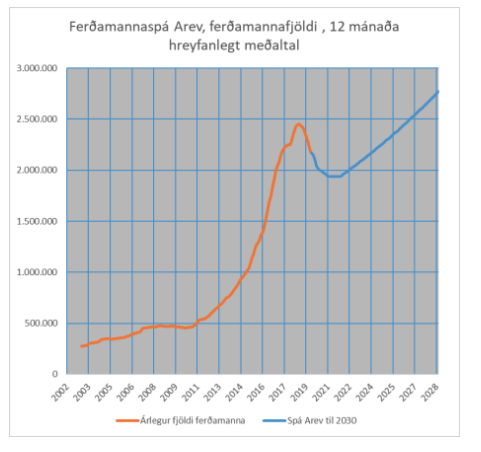
The right-hand axis of the chart to the side shows that, until mid-2017, the annual average continued to increase. In 2017, this reversed. In November 2019, there were 11.3% fewer tourists than the previous year. As a result, the annual average fell by 11%. The average is now just over 2.1 million. Arev expects it to be around 2.0 million by mid-2020 and 1.9 million a year later, as the chart shows.
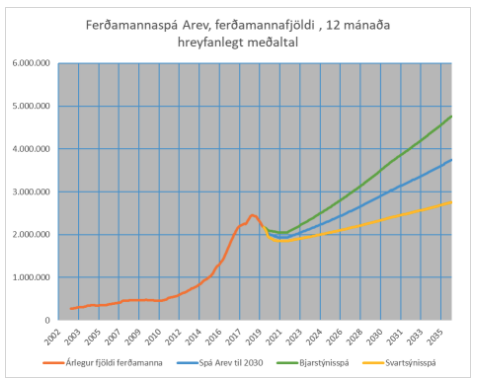
Arev then set up two other scenarios. According to the optimistic scenario (the green line), the average will fall to just over 2 m. by mid-2021 and then start to rise again. According to the pessimistic scenario (the yellow line), the average will fall to just over 1.8 m by mid-2021 before it starts to rise again.
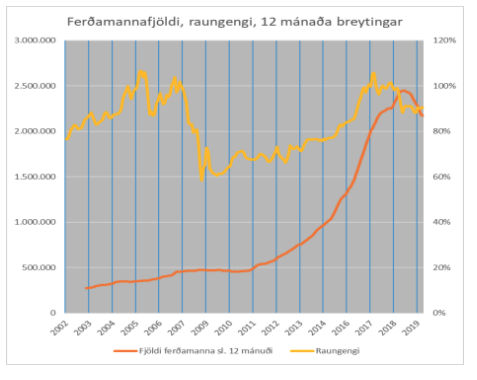
Finally, here is a figure on the side showing the relationship between the real rate and
number of tourists. The yellow line shows the real exchange rate of the Icelandic króna and
The brown line number of tourists. A significant increase in tourists on
In recent years, demand for factors of production has increased significantly.
such as labour, and push up the real exchange rate.