
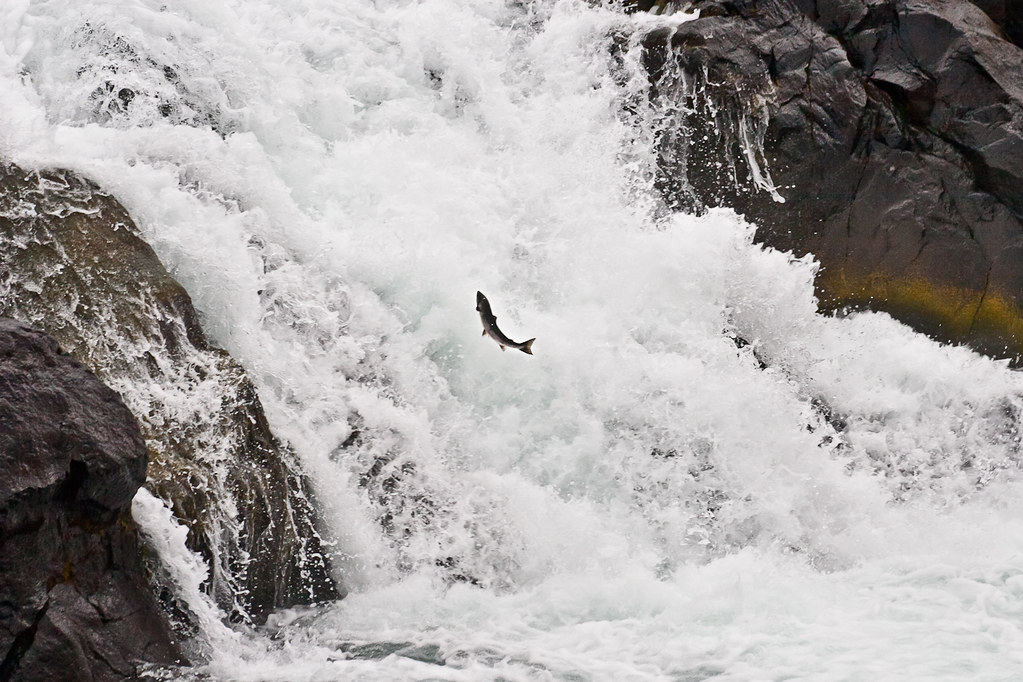
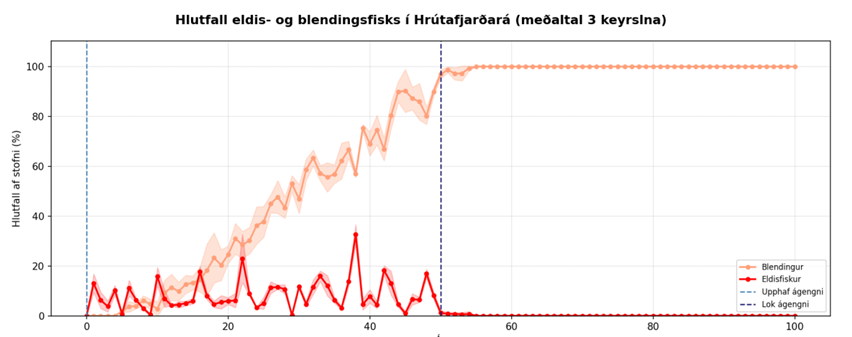
An IBSEM modelling study by Arev for Hrútafjarðará in North Iceland shows a considerably more severe outcome than our earlier analysis of Hofsá and Selá in Vopnafjörður. The model assumes open-net-pen farming operates — with fish escaping into the river — for 50 years, then stops completely; the remaining 50 years of the 100-year simulation track what happens with zero further farming pressure. The result is stark: hybridization becomes so pervasive, so fast, that genetically pure wild fish effectively disappear from the population within a few years of the last escape — and do not return for the rest of the simulated century.
Why population size matters
Hrútafjarðará supports a comparatively small wild salmon population. Lacking direct water-temperature records for the river, Arev calibrated the model using the monthly average of neighbouring Gljúfurá and Vatnsdalsá over the last five years, and set the river’s effective habitat area at 110 km² based on independent population estimates for Hrútafjarðará and Síká. At that calibration, the model produces a mean spawning population of 400 fish (SD 68), closely matching an independent estimate of 412 (SD 41) — giving confidence that the model reflects the real population.
That small population size turns out to be decisive. The same modelling approach that produced 15–30% hybrid shares in the larger Hofsá and Selá populations produces far more extensive hybridization in Hrútafjarðará: escapees and their offspring make up a much larger share of a population this size.
Fifty years of farming, then fifty years without it — still no wild fish
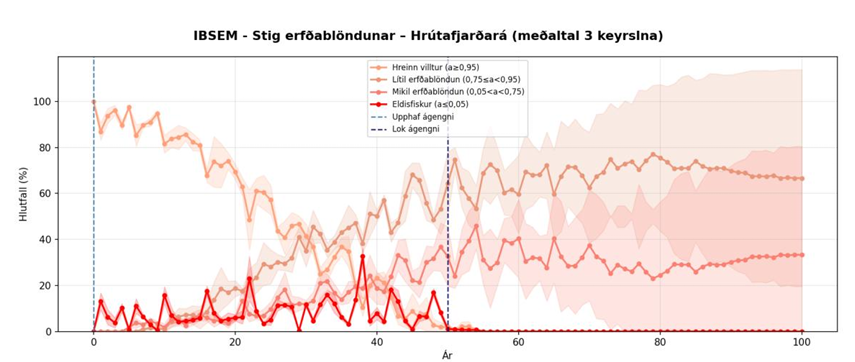
The model tracks four genetic classes based on the frequency of wild alleles (a): pure wild (a≥0.95), low introgression (0.75≤a<0.95), high introgression (0.05<a<0.75), and farmed (a≤0.05). Over the 50-year farming period, the farmed-fish share of the spawning population peaks at around 33%. Hybrids — mostly falling into the high-introgression class — keep accumulating, and by the time farming stops (year 50), hybrids and farmed fish already make up about 97% of the spawning population. Crucially, that trend does not reverse once escapes stop: the combined hybrid-and-farmed share keeps climbing to 100% by year 55 — just five years after the last escape — and stays there for the remaining 45 years of the simulation. The mirror image: genetically pure wild fish, 100% of the population at the outset, fall to roughly 2% by year 50 and are essentially zero by year 54. They do not recover at any point in the following 46 years — that is, even after half a century with no further farming pressure at all. On the basis of this model, it looks unlikely that genetically wild salmon, as distinct from hybrids, would be found in Hrútafjarðará again, even 50 years after all open-net-pen farming activity there stopped.
Definitions
The model classifies each fish by the frequency of wild alleles it carries (a): pure wild (a≥0.95), low introgression (0.75≤a<0.95), high introgression (0.05<a<0.75), and farmed (a≤0.05). Fish in the two introgression classes are counted as hybrids. The population-wide average frequency of wild alleles fell to about 0.55 at the fry stage during the farming period and reached roughly 0.80–0.85 by year 100, against an original baseline of about 0.95.
Key findings
- Even after 50 years with zero further farming, genetically pure wild fish do not return — the collapse happens fast (within about five years of the last escape) and does not reverse.
- Population size is a critical risk multiplier: identical escape numbers have a far larger relative effect on a small population than a large one.
- This is not a mid-farming snapshot: the model runs 50 years of active farming followed by 50 years of zero escapes, so the result reflects the long-run outcome once farming has completely stopped, not a temporary low point.
- Even 100 years on, essentially no fish in the population qualifies as genetically pure wild, and average wild-gene frequency has not returned to its original baseline.
For river owners and fishing associations
An analysis like this gives river owners and fishing associations the tools to quantify genetic introgression risk specific to their own river — including how population size shapes that risk — build evidence for environmental impact assessments and permit proceedings, and compare conservation measures and their long-term effects.
Wild salmon rivers near open-net-pen farming operations, especially smaller ones, may face substantially greater genetic risk than larger neighbouring rivers. Arev can carry out an IBSEM analysis for other rivers. Contact us to learn more or request a quote.